

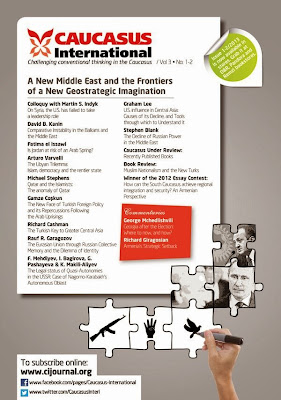
Please read my new article called: "Legal Status of Quasi-Autonomies in USSR: Case of Nagorno-Karabakh's Autonomous Oblast" published in the new issue of Caucasus International in collaboration with F.Mehdiyev, I.Bagirova and G.Pashayeva.
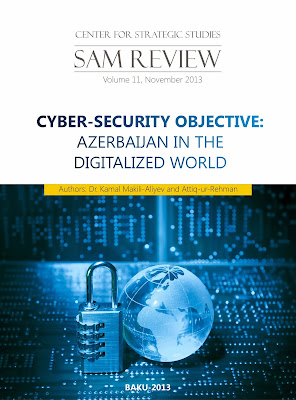
Please read my new publication with the Center for Strategic Studies under the President of the Republic of Azerbaijan in a new SAM Review #11 called "Cyber-Security Objective: Azerbaijan in the Digitalized World" in collaboration with a PhD scholar at Quaid-I-Azam University Islamabad, Pakistan - Attiq-ur-Rehman.
Распоряжение Кабинета Министров Украины от 21 ноября 2013№ 905-р о приостановке подготовки Украины к подписанию Соглашения об
ассоциации с Европейским Союзом вызвало лихорадку в стране и вывело людей на
улицы. Особенно следует отметить воскресные протесты, на которые по самым
пессимистичным оценкам собралось 25 тысяч человек, сконцентрировавшиеся на двух
основных площадях Киева – Майдане Независимости и Европейской площади.
Хотя
ситуацию с протестами невозможно назвать вышедшей из под контроля, следует
отметить, что настроения у протестующих явно самые серьезные. Некоторые вчерашние протесты, например, уже ставили
целью блокирование здания правительства и привели к столкновениям с
правоохранительными органами. В тоже время лидеры оппозиции зарегистрировали в
Верховной Раде проект
постановления об отставке правительства.
Возникает
вопрос о том куда движется политическая ситуация на Украине которая с четверга
лихорадит страну? Для того, чтобы несколько прояснить ситуацию следует
несколько абстрагироваться от гневной реакции на ситуацию и учесть правовой,
внешнеполитический и внутриполитический аспекты события.
В
правовом аспекте существует интересная деталь которую, кажется, упускают из
виду как пресса, так и протестующие. Приостановление евроинтеграционной
политики произошло распоряжением правительства Украины – фактически
нормативно-правовым актом исполнительного характера. Юридическая сила такого
нормативно-правового акта не очень высока по сравнению с законами Верховной
Рады или указами Президента. Кстати, Президент достаточно абстрагирован от
процесса и его инициативы не было видно в принятии Кабинетом Министров этого
рокового распоряжения, хотя основная доля протестов направлена именно против Януковича. Он также обошел данный вопрос и в
своем выступлении
в понедельник. Это в свою очередь позволяет сделать вывод о ключевой роли в
данной инициативе премьер-министра Азарова. Интересная деталь, которая намекает
на внешнеполитический аспект.
Дело в
том, что в распоряжении в качестве рационали отмечается необходимость «более
детального изучения и проработки комплекса мероприятий, которые необходимо
осуществить для восстановления утраченных объемов производства и направлений
торгово-экономических отношений с Российской Федерацией» и восстановление
активного диалога «с Российской Федерацией и другими странами Таможенного союза
и государствами – членами Содружества Независимых Государств по оживлению
торгово-экономических связей с целью сохранения и укрепления совместными
усилиями экономического потенциала государства».
Украина
находится в сложной ситуации. МВФ не торопится предоставлять 15 млрд. долларов
США необходимых стране для закрытия бюджетных провалов. С другой стороны
подписание ассоциативного соглашения с ЕС, может вызвать реакцию со стороны
России, которая откажется от импорта украинских товаров, что может означать
ужасные экономические проблемы для всей восточной части Украины, если не будет
финансовой помощи со стороны международных финансовых институтов. Таким
образом, оттягивая подписание соглашения с ЕС, правительство может надеяться на
отложение санкций со стороны России, одновременно пытаясь выиграть время на
получение денег от МВФ. Вопрос в том, не повредит ли такая ситуация в равной
степени доверию как ЕС, так и России по отношению к украинской внешней
политике? Ведь до Вильнюса уже всего ничего.
Все перечисленное
наводит на мысль о том, что в нынешней администрации Украины еще нет
окончательного решения о том, когда подписывать ассоциативное соглашение с ЕС и
подписывать ли его вообще. Это приводит нас уже к внутриполитическому аспекту
ситуации.
Учитывая
текущие настроения в стране, четкую позицию ЕС, железно подтверждающую
намерения по ассоциации и заручившись обещаниями финансовой помощи от своих
западных партнеров, Президент Украины вполне может отменить распоряжение
правительства и поехать в Вильнюс подписывать соглашение с ЕС. Таким образом он
сможет достичь сразу несколько целей: 1) воспользовавшись ситуацией добиться
наконец обещаний финансовой помощи; 2) существенно поднять свой рейтинг как человек
спасший евроинтеграцию; 3) и возможно использовать ситуацию для того чтобы
добиться отставки премьер-министра Азарова как скомпрометировавшего курс
развития страны. Гамбит премьер-министра со стороны Президента при этом, скорее
всего, усилит позиции вице-премьера Арбузова и поменяет расклад властных
группировок, который будет больше отвечать интересам Президента Януковича.
Какой бы ни был вариант
развития политической ситуации ясно, что открывается более широкое поле для
маневра, которым в Украине будет пытаться воспользоваться большое количество
политических сил, а Майдан как всегда будут сотрясать простые граждане.
Kamal Makili-Aliyev
Doctor of Laws (LL.D)
25.11.2013
1news.az25.11.2013
Cyber-warfare is on the table of many contemporary military planners. Today they are trying to identify the role which cyber-weapons will have in wars of tomorrow. As cyber-weapons have proved to have corporeal physical effects that can be used as a means of war, it is clear that states are getting progressively concerned with their critical infrastructures (CI). For example, just recently Federal Bureau of Investigations and Department of Homeland Security in U.S. have issued warnings of possible cyber-attacks that can come from so-called “Syrian Electronic Army”, whose hackers have been targeting U.S. for sometime already. Security institutions in U.S. are thus especially concerned with situation ahead of possibility of military attack on Syria.
As states progressively depend on
the intricate networks of infrastructures that provide functionality for the
living frameworks such as housing, food, trade, communications, etc. the
threats of the collapse of such infrastructures present challenges to national
security. It has to be taken into account, that before weapons that could have
damaged such infrastructures to catastrophic results required a lot of
resources for their development and certain conditions for their deployment,
such as for example the situation of an armed conflict. Today, the
cyber-weapons are very easily procured with very limited resources and can be
easily deployed without barrier of certain conditions.
What is most worrisome is the
possibility of cyber-attacks on industrial control systems (ICS, or also known
as SCADA systems) that can bring malfunctions in such systems as energy grids, oil
and gas pipelines, critical communications of transportation, water-dams and
cause their destruction with effect immediately targeting large group of civilian
populations. Taking down train-control systems that will result in derailing of
the locomotives are unlikely to directly target military objectives, the same
can go to water-dams sabotage and the resulting flood.
As studies show SCADA systems can be
very vulnerable to cyber-attacks and can be exploited to the point where the
false information is inserted into the system (through so-called “worms” or
other malicious software) and can have kinetic effect of collapse of the
physical system within a matter of minutes if not seconds. At the same time
isolation of the systems and going back approximately 30 years (when computer
network systems didn’t exist) is not feasible anymore.
Described threats may be felt first
of all by the oil and gas SCADA as they can be tempting targets for many
politically motivated cyber-attackers. For certain states, for example, such as
Turkey, Azerbaijan and Georgia (TAG) such situation should not be overlooked.
Linked by the network of oil and gas pipelines of last generations these
countries undoubtedly use the latest models of SCADAs. It has to be pointed out
that such networks of pipelines will only grow in size and numbers according to
the development plans of these states. Moreover, these countries are also
linked by the Trans-Eurasian Information Super Highway (TASIM) project. TASIM
is going to connect through fiber-optic line countries of Western Europe with
Eastern Asia passing through TAG countries in the process making their
respective cyberspaces even closer and comparable with their pipeline
cooperation. The importance of the project is highlighted by the recent
discussion in the UN General Assembly on September 4, 2013. With that in mind
it has to be taken into account that though technological progress and
integration can facilitate economic and social growth it also presents the
stakeholders with certain security vulnerabilities.
It is logical then that SCADA systems
should be protected. However, as undoubtedly a large number of technicians are
working around the globe to boost cyber-security for industrial control
systems, there always going to be a race between them and cyber-attackers. Another
way of protecting SCADA systems is outlawing the attacks on such systems
internationally. It is clear that such attacks will bring more damage to
civilians rather that military objects and can be used more like the means of
terror rather that means of war to achieve legitimate military objectives. With
that in mind it is clear that such cyber-attacks should be banned as use of
chemical and biological weapons, as terrorism, as illegitimate use of force. It
should be done now to prevent the states from being tempted to use such
cyber-attacks as covert options of “untraceable” use of force, due to the
difficulties of attributing of a cyber-attack to the particular state.
Hence, there is a possibility for the group of countries
like TAG to raise awareness and influence international community to the problems
on cyber-attacks on CI. Through projects such as TASIM they can address the
states bringing their attention to both great opportunities of integrated
cyberspace as well as the need of joint action in international cyber-security.
Kamal Makili-Aliyev
Doctor of Laws (LL.D)
21.11.2013
Turkish Weekly
Please read my new policy paper: "Impact of the U.S. Withdrawal from the South Caucasus on the Regional Security of the Caspian Basin" published in the course of research in Institute for Training and Development's National Security Institute - in common publication "Post-Hegemonic Global Governance". The excerpt with my policy paper can be found here.

Please read my new article on Security Sector Reform in Azerbaijan in new book by Centre for European and North Atlantic Affairs - "Security Sector Reform in Countries of Visegrad and Southern Caucasus: Challenges and Opportunities" M.Majer ed. that can be found here.
The digital age is already here.
While these
systems can be linked in cyberspace to create so many beneficial opportunities,
it is worth mentioning that such a situation has also paved the way to a large
number of emerging security threats -- cyber-threats. Only a decade ago concern
about cyber-attacks was limited to the possible inconvenience it might create
in cyberspace. However, once it was proven by “Stuxnet” that a cyber-attack can
have a very real impact in the physical world, the situation started changing.
Suddenly cyber-warfare has stopped being a theme of science fiction and of
certain vanguard analysts who are mocked as doomsayers. It is only logical
that, in anticipation of possible cyber-conflict, states have started the
process of “cyber-arming.”
Given the
recent developments in the situation, as the power of the Internet is
conquering the world today, such a process seems only logical. The National
Security Agency leaks situation created a lot of headaches related to digital
privacy across the globe. The fact that the monitoring of both private and
official electronic communications has been laid out on the table undoubtedly
made a lot of governments across the globe concerned. Revision of the domestic
systems of electronic communications, including the responsible use of
commercial email accounts, is long overdue in many countries. Moreover, the
recent situation with retired Gen. James Cartwright and the cyber operation
known as “Olympic Games” that included the cyber-attack on Iran's nuclear
program is only making the urge to cyber-arm more justified. Nonetheless, in such
a tense cyber-environment, there is a need to distinguish between the countries
concerned with internal and external threats to their cyber-infrastructure.
Such a difference is quite evident in the comparison of the US and Brazil.
The US has
suffered from large-scale cyber-attacks over the last five to seven years. At
the same time it has been able to adapt to the changing circumstances and come
up with both cyber-strategy and the US Cyber Command (CYBERCOM) to have an
adequate response to threats in cyberspace. Most of the recent estimations by
the experts and organizations that analyze threats prove that at the top of the
list for the US is cyber-threats. Moreover, these threats are likely to
originate outside the US from non-state actors, which are gaining a lot of
expertise in using cyberspace offensively. As the nature of threats is
shifting, so is the need to have a comprehensive defense system that would also
be able to implement proactive measures. Such reasoning is behind the process
recently started by CYBERCOM to establish a set of teams over the next several
years to maintain an adequate response to the external cyber-threats. The
increasing offensive cyber-capabilities prove there is a need for the
militarization of cyberspace and that the notion of cyber-defense is almost
equal to its traditional counterpart. It is thus possible that CYBERCOM will
only be expanding in the near future.
On the other
hand, for such a prominent regional power as Brazil, the nature of
cyber-threats lies in the heart of the country itself. Brazil is riding the
recent wave of rapid development and growth, and it is in its interests to
ensure that its critical infrastructure, financial and banking systems and
communications are stable and safe. The digitalization of the country as a
natural outcome of growth is creating additional security challenges in these
areas. The cyber-threats originating from individuals and groups targeting
banking systems and websites inside the country for both criminal and political
reasons have been transformed into the next level of policy headache for the
Brazilian government to deal with. While “hacktivists” and cyber-criminals are
part of the internal framework of cyber-threats, Brazil realized that boosting
its cyber-defenses to maintain domestic infrastructure should be done in
concert with the creation of a comprehensive cyber-defense system that would
respond to new threats that may arise in the future as well. With that in mind,
the cyber-defense center CDCiber was created under the Brazilian Ministry of
Defense. The center has large defensive capabilities to protect the national
networks as well as providing coordination for its partners and serves as a
unified body for cyber-security in the country. CDCiber has already proven
itself capable of protecting the networks of the UN Rio+20 sustainable
development conference and recent Confederation Cup football.
These examples of cyber-arming are only a small part of the general
trend that is seen in the dynamics of the development of many other states both
large and small. In this contemporary environment of “cyber arms race,” the
lack of international regulations on cyberspace is making the future even more
uncertain. With states so concerned by both internal and external
cyber-threats, and international legislation already overdue, it is about time
to acknowledge that soon we may experience the first real cyber-war.
Kamal Makili-Aliyev
Doctor of Laws (LL.D)
29.06.2013
Please find my new paper discussing perspective of Azerbaijan on border security issues in EU Eastern Partnership here. Paper analyzes the path of Azerbaijan in developing its border security in accordance with EU standards and norms and provides recommendations to both EU and Azerbaijan on further such development.
Kamal Makili-Aliyev
Doctor of Laws (LL.D)
01.04.2013
Subscribe to:
Posts (Atom)
